An Incredible Mind in a Perfect World
- Josephine Akinwumiju
- Nov 4, 2024
- 4 min read

Updated: Nov 26, 2024
Have you ever wondered what it takes to memorize lines for a school play, remember formulas for a math test, or even recall your best friend’s phone number? While it is true that most of us do not remember phone numbers off the top of our heads anymore, this example highlights the incredible capability of our minds to retain information and call on it when needed. From complex calculations to the lyrics of a favorite song, our brains are constantly managing, organizing, and storing data in ways that often go unnoticed. Information Processing theory helps explain this remarkable process by examining how we encode memories, exploring the ways we acquire, store, and retrieve information (Cloke, 2022).
Multiple models have been created to show this phenomenon, beginning with Atkinson and Shiffrin in 1968.
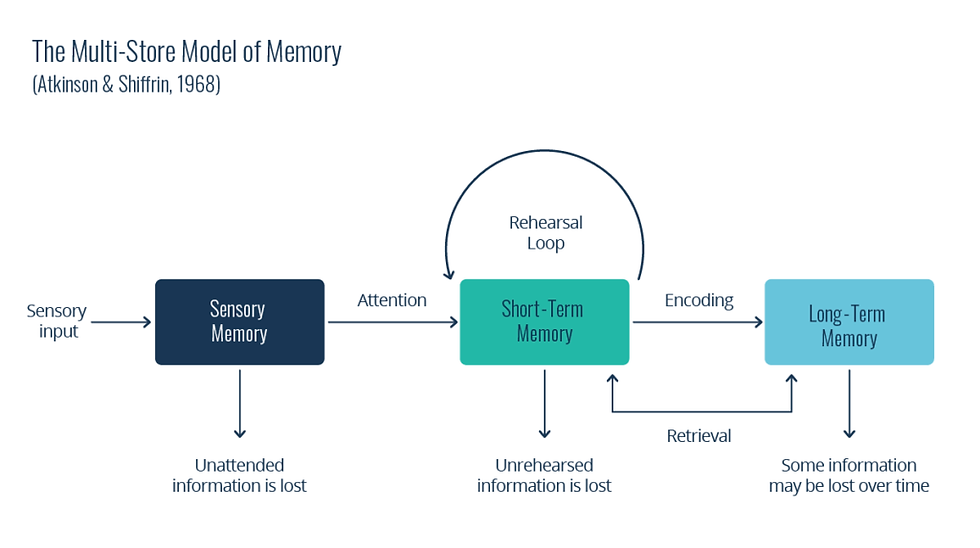
Their model shows how information is retrieved through our senses, filtered, and focused, allowing it to enter into our short-term memory. This selective attention process ensures that only important information progresses through the stages of memory. From there, the transfer of information from short-term to long-term memory is known as encoding. Then, the retrieval process involves accessing memories from long-term memory and bringing them back into short-term memory for use (Challenge, 2021).
In 1974, Baddeley and Hitch updated the model to present a more detailed view of working memory.
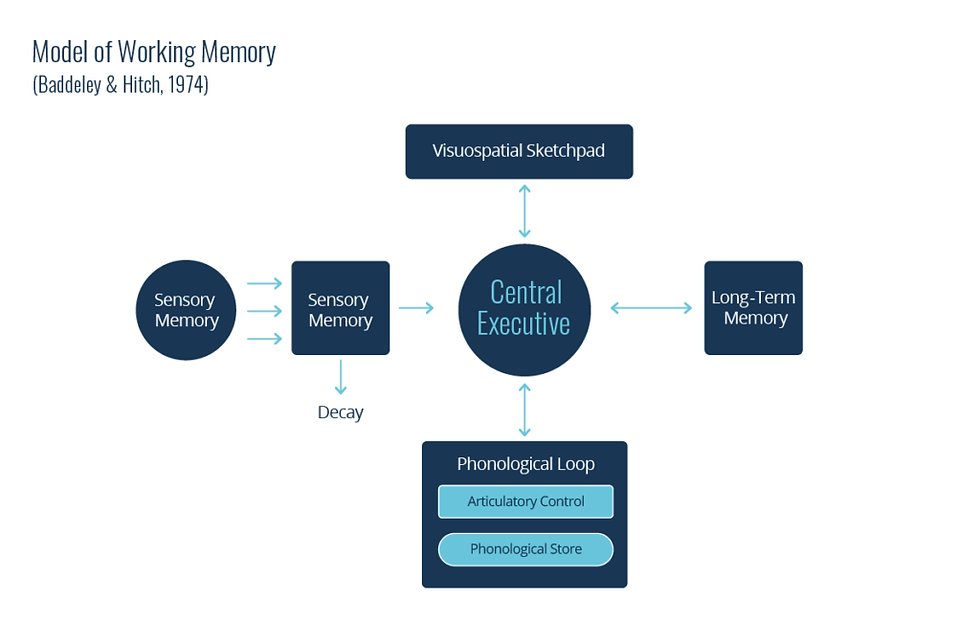
While Information Processing theory and its models shed light on our ability as learners to learn, retain, and recall vast amounts of information—demonstrating just how impressive our brains are—Atkinson and Shiffrin did not fully account for real-world experiences or environmental factors that can impact learning and memory. The Central Executive shows us just how differently the brain processes information and the steps needed to adequately encode and store information, but it also shows us how easily it can be interrupted. For instance, factors like stress, sleep, and the physical learning environment can all influence how well we process and recall information (Baddeley & Hitch, 1974; Paas & Sweller, 2014). When we are stressed the central executive functioning becomes impacted, making it harder to prioritize and filter out distractions. You are constantly worrying about other “more important matters” so the information you are supposed to be learning is harder to focus on. It is the same for sleep as well. When you are exhausted or even not getting enough sleep you are not giving your brain enough time to adequately store the information. We unfortunately do not live in a perfect world; thus, limitations exist. The Information Processing computer analogy fails to consider how emotional and motivational factors affect a human’s cognition (Cloke, 2022).
This is where Universal Design for Learning (UDL) and trauma-informed learning come into play. UDL is an approach to curriculum design that minimizes barriers and maximizes learning for all students. When the curriculum is designed for neurodiverse learners—those with varying cognitive, emotional, and sensory needs—it creates a better learning environment for everyone (CAST, 2010). If we consider the three principles of UDL—representation, action and expression, and engagement—we can observe how they align well with the Information Processing theory. Offering multiple means of representation allows students to engage with content in a way that suits their learning needs. The information is presented in ways that could trigger both the iconic and echoic memory, giving the learning a choice of which way they want to remember the information, thus aiding in encoding and comprehension of the material. Additionally, allowing varied ways to express learning supports retrieval and application by letting students demonstrate their knowledge in ways that align with their strengths. The retrieval process could become more streamlined if learners can consider more than one method of retrieval.
Additionally, trauma-informed learning acknowledges that past adverse experiences can impact students’ ability to focus, retain information, and engage fully in the learning process. Trauma-informed practices create a supportive environment that prioritize emotional and physical safety, build trust, foster strong relationships, encourage collaboration, and empower learners, all while being sensitive to cultural, historical, and gender issues (Giacomucci, 2021). When educators understand the impact of trauma and integrate practices that accommodate students' needs, they remove barriers that may prevent students from engaging meaningfully with learning material. This approach acknowledges that learning isn’t just a cognitive process, but a holistic one influenced by each student’s emotional and environmental context. Thus, if a learning environment is promoting trauma informed learning, imagine how much easier it would be for a learner to process and encode the necessary information.
The brain is a remarkable organ because it can process and store an infinite amount of information. The Information Processing theory provides a fascinating insight into how this process works, breaking it down into stages of encoding, storage, and retrieval. This model operates as though we live in a perfect world, where learning happens seamlessly and without interference. It does not fully account for the complexity of our human experiences, emotions, or the environmental factors that can impact our ability to learn and remember. When paired with frameworks such as UDL and trauma-informed learning, these gaps can be bridged, making learning more accessible, responsive, and effective for everyone.
References:
Baddeley, A. D., & Hitch, G. J. (1974). Working memory. Psychology of Learning and Motivation, 8, 47-89.
CAST. (2010, January 6). UDL at a glance [Video]. YouTube. https://www.youtube.com/watch?v=bDvKnY0g6e4&t=57s
Challenge Innovate Grow: Teacher & Learner Centre. (2021, March 15). Information processing theory [Video]. YouTube. https://www.youtube.com/watch?v=ENzV7nVLuhk
Cloke, H. (2022, August 2). What is Information Processing theory? Growth Engineering. https://www.growthengineering.co.uk/information-processing-theory/
Collin, B. G (2019). Information Processing Theory Explained [Video]. YouTube. https://www.youtube.com/watch?v=aURqy9BEJO4
Giacomucci, S. (2021). Trauma informed principles & practices [Video]. YouTube. https://www.youtube.com/watch?v=ANRlWfuWOGQ

Comments